How We Saved Money By Being Picky About Ad Exchanges
CTV Exchange Strategy Whitepaper
Executive Summary
Connected TV (CTV) has emerged as the fastest-growing segment in political media. In 2024, programmatic CTV ad impressions surged by 24%, capturing 50% of digital video spend—up from 30% in 2022. At the same time, total TV streaming now accounts for roughly 45–46% of all viewing, outracing broadcast and cable combined.
As political campaigns pivot to this booming medium, many DSP strategies encourage broad targeting across multiple ad exchanges, aiming to maximize reach and efficiency.
In this test, we explored an alternative approach to see how a more focused strategy would compare.
Our test ran from July 3–16 in a major omnichannel campaign with a mid-five-figure budget, comparing two CTV strategies:
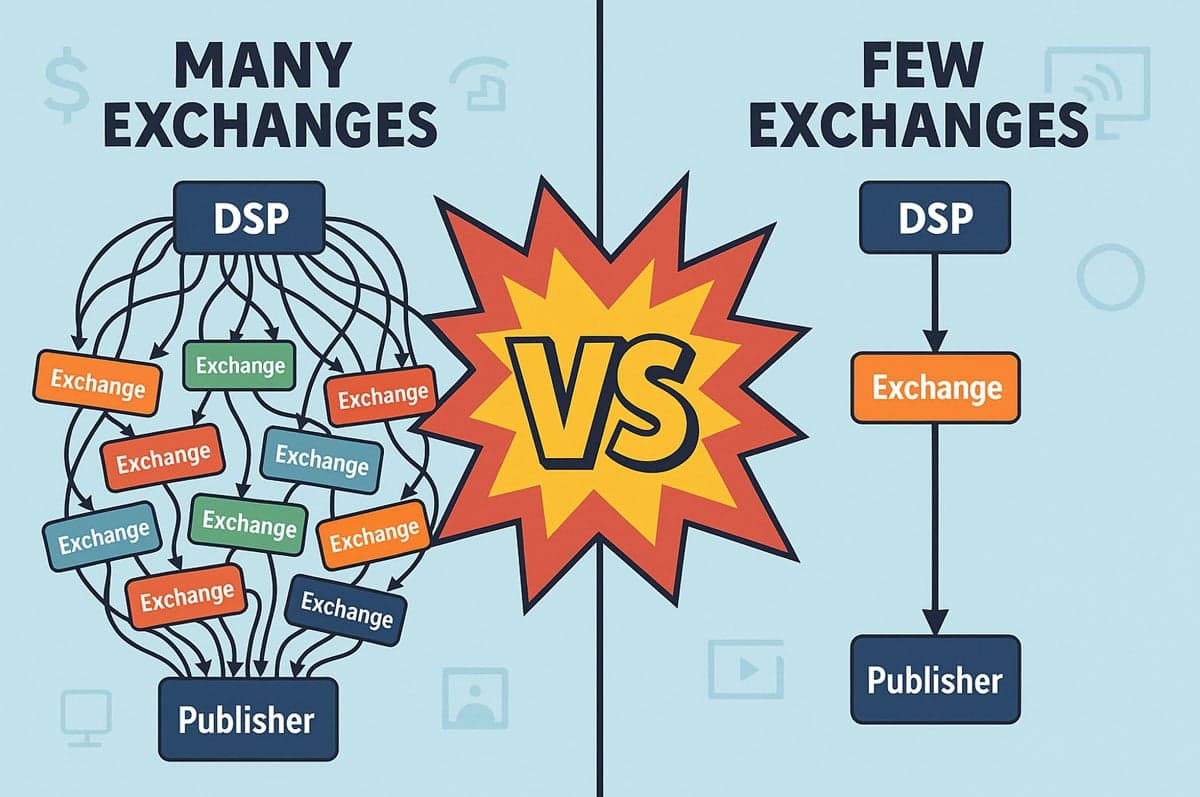
- "Few Exchange" Variant — targeting a single high-scale exchange (Magnite).
- "Many Exchange" Variant — targeting 35+ ad exchanges via DSP-default settings.
Despite its simplicity, the "Few Exchange" approach matched or exceeded the "Many Exchange" approach on key metrics:
- 📈 Lower CPMs (10-15% difference)
- 🏠 Marginally better cost per household
- 🔄 Higher frequency, with equivalent reach
For political advertisers who face compressed timelines, tight budgets, and compliance scrutiny, this evidence suggests that curating your exchange mix can yield better control, transparency, and efficiency.
Why CTV Strategy Matters More Than Ever
CTV isn't just growing, it's dominating. A recent report shows CTV captured 50% of political digital video spend in 2024, rising from 30% in 2022, with impressions up 24% year-over-year. According to Nielsen, streaming nationally has reached a historic milestone—46% of all TV viewing—eclipsing broadcast and cable combined.
This shift isn't abstract; it's reshaping how political campaigns communicate. With streaming now commanding nearly half of total viewing, political advertisers can't ignore the channel.
The Cost of Chasing Scale vs. Smart Buying
Despite CTV's scale, programmatic buying paths remain complex. While DSPs often recommend targeting numerous exchanges to maximize reach, this can sometimes lead to tradeoffs in inventory control, creative management, and supply chain transparency.
As exchanges like Magnite and Pubmatic launch self-serve platforms, advertisers face a choice: maintain a broad, automated DSP-based approach, or experiment with a more selective strategy focused on efficiency and transparency.
Our Hypothesis
We hypothesized that targeting one well-scaled CTV exchange, rather than 30+, could:
- Match reach due to high audience coverage
- Improve efficiency by lowering CPMs and simplifying frequency control
- Increase transparency, making supply paths easier to audit and manage
How We Tested It
We ran this test alongside our friends at AdVictory, using log-level data to establish measurement parity and examine the supply path.
We structured this test using two identically configured ad groups:
- Few Exchange — Targeted only Magnite, picked because it has 99% market coverage (per Jounce)
- Many Exchanges — Targeted 35+ exchanges using our DSP's default recommendation.
Key constants across both groups:
- Audience: Women 35–64 in a mid-size Southeastern U.S. city (150K addressable households)
- Creative: Identical across both groups
- Budget: Matched spend across groups
- Brand Safety: Enabled via DoubleVerify + custom blocklist
- Format: CTV-only
- Dates: Summer 2025
The Results
| Metric | "Many Exchange" Group | "Few Exchange" Group |
|---|---|---|
| Frequency | 16.3 | 18.3 |
| CPM | - | 12% cheaper |
| Cost per Household Reached | $0.22 | $0.20 |
| Supply Vendors | 39 | 1 |
| Unique Apps & Devices | 398 | 302 |
What jumped out to us:
- The Few Exchange setup delivered better cost efficiency without sacrificing reach.
- Frequency was slightly higher—potentially due to the more controlled bidding path.
- The reach delta was negligible despite a 39x increase in supply vendors for the Many Exchange group.
Takeaways for Political Advertisers
- You don't need 30 exchanges to run an efficient CTV campaign.
- Being selective gives you more control over QA, fraud, and creative approvals.
- CTV budgets are growing rapidly—so are the risks of waste and redundancy.
- Streamlined and deliberate execution offers advantages in high-pressure campaign environments.
As political CTV spend continues to rise, efficiency is no longer a nice-to-have; it's the difference between waste and impact. This test proved something simple: fewer exchanges can be better.
We encourage buyers to explore this strategy and gain greater visibility into how their DSPs optimize buying paths and inventory selection.