CTV Buying in an Election Year: What We Learned in Our 8-Figure Stress Test
Best CTV Buying Tools for Political Campaigns
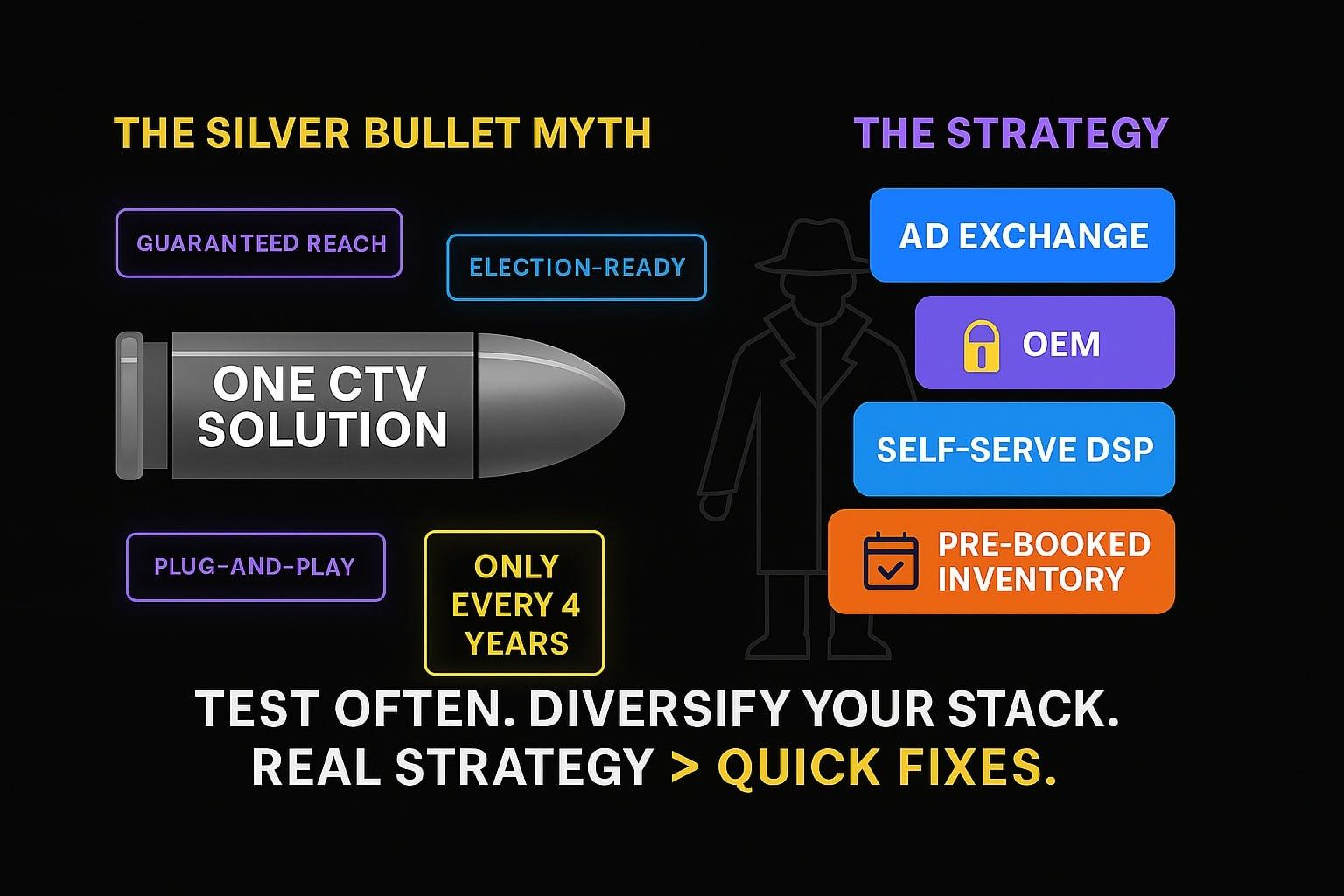
In political advertising, there's one guarantee every cycle: a flood of ad tech vendors promising the best way to buy Connected TV. And that shows no signs of slowing down for one reason: Over $2.3 billion was spent on CTV (AdImpact) in 2024, which tells us that the marketplace is more crowded, and confusing, than ever.
So we did what any other digital agency worth their chops should do - we tested the top CTV buying tools to see which platforms actually delivered for political campaigns, measuring performance across a series of different factors and KPIs.
How We Tested CTV Buying Tools for Political Campaigns
To evaluate CTV buying platforms across a range of political campaign needs, we scored each on four core criteria:
- Valid, Viewable, and Fraud-Free Inventory: Measured by DoubleVerify. Defined as an app that is fully on screen and 100% viewable by the target audience, for a minimum of 2 seconds, free of fraudulent inventory.
- Quality: Also measured by DoubleVerify. We created custom parameters that measure in-app CTV views as "authentic" based on the environment our ads appear in, free from sophisticated invalid traffic (SIVT). We also used a proprietary database of "attentive" CTV apps to gauge how traffic indexed against known bad-players.
- Efficiency: A weighted average of the gross CPM of our campaigns.
- Reach: A weighted metric defined by our ability to reach unique people in our audience, measured against different identifiers.
We scored each tool on a 0–25 scale, with scores standardized based on performance across similar buys and campaign contexts. All four categories were weighted evenly to ensure a level playing field across CTV strategies.
Here's what we learned.
Direct-to-Exchange "DSPs" Rule for Targeting Niche Voter Segments
For a PAC advertiser targeting a highly specific voter file, we tested a range of platforms, including self-serve DSPs, ad exchange-direct-based "DSPs" (like Magnite's Clearline or PubMatic's Activate), and a managed service vendor. These ran during a multi-state buy from August through October.
Because our audience targeting criteria was extremely narrow, we relied on first-party data and multiple onboarding vendors.
Among the platforms, ad exchange-based DSPs performed best. They achieved higher audience match rates and reduced auction pressure, allowing for more efficient bidding. While viewability and quality were comparable across platforms, ad exchanges outperformed due to their proximity to the programmatic bid stream, giving them better visibility into user behavior and higher precision in audience targeting.
The managed service vendor we tested underperformed across the board, with steep markups killing both efficiency and reach, which are two critical factors for custom audience targeting.
| Score | Type | Viewability Score | Quality Score | Efficiency Score | Reach Score |
|---|---|---|---|---|---|
| 13.00 | Ad Exchange | 69.60% | 92.83% | -49.35% | -62.61% |
| 10.78 | Self Serve | 86.11% | 89.27% | -60.56% | -73.14% |
| -0.89 | Managed Service | 96.46% | 98.38% | -100.00% | -100.00% |
Takeaway? Consider working directly with an ad exchange if you're trying to reach a tough audience for a political ad buy in competitive states.
Reminder: Our scoring methodology is explained HERE.
Omnichannel DSPs Dominate for Everyday Political Buys
For ongoing or non-competitive political ad buys (defined here as placements under $500K spread across more than two weeks) self-serve DSPs are the clear winners. In these scenarios, scale isn't the top priority, rather performance, efficiency, and cost control are.
Platforms like The Trade Desk, DV360, Viant, StackAdapt, and IQM performed well. These self-serve CTV tools offered advertisers granular control over CTV costs, quality, and pacing. These tools delivered strong results across all key metrics without tight audience constraints or major auction pressure.
On the flip side, managed service platforms struggled again, hampered by inflexible quality controls and markups that eroded efficiency.
| Score | Type | Viewability Score | Quality Score | Efficiency Score | Reach Score |
|---|---|---|---|---|---|
| 17.61 | Self-serve DSP 1 | 86.11% | 97.61% | -55.28% | -57.98% |
| 15.63 | Ad Exchange 1 | 100.00% | 96.91% | -74.91% | -59.49% |
| 15.02 | Self-serve DSP 2 | 97.15% | 98.17% | -55.10% | -80.15% |
| 5.97 | Ad Exchange 2 | 79.65% | 93.16% | -48.93% | -100.00% |
| 5.37 | Managed Service 1 | 86.15% | 66.62% | -88.23% | -43.07% |
| -0.50 | Managed Service 2 | 91.77% | 85.20% | -100.00% | -78.95% |
Takeaway? If you don't have a lot of pressure on scale and tight audiences, execute this buy using the myriad of cool self-serve DSPs that are taking over the political advertising space.
Reminder: Our scoring methodology is explained HERE.
When It's Election Crunch-Time, No One Scales Better Than OEM DSPs
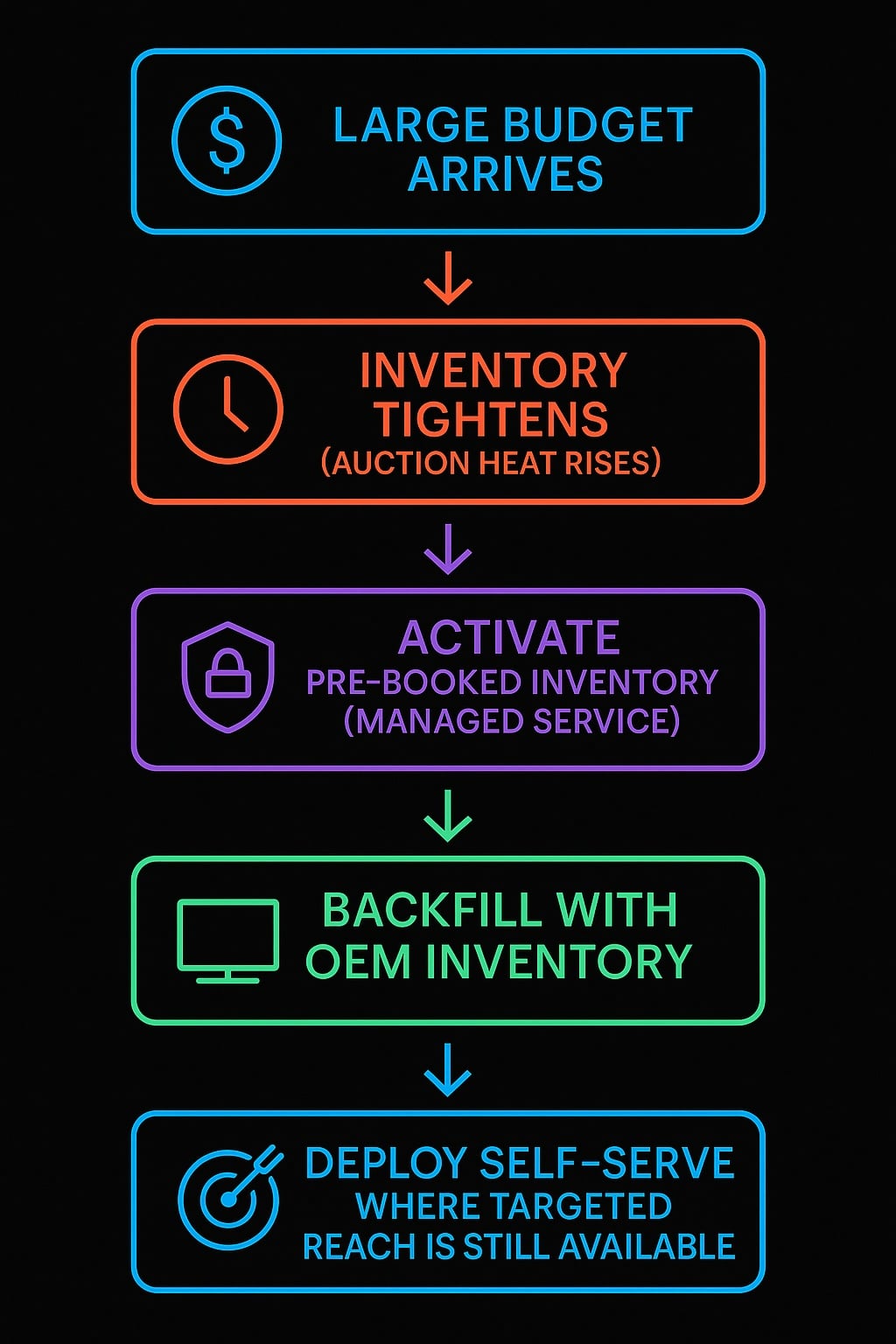
This is a problem that lots of agencies are struggling with in late-October of an election year. Money comes pouring in, but the tools they're currently using are struggling, and not built for the cycle. You've just been handed an 8-figure budget, and only have 2 weeks to spend it. What's the right approach?
We found two standout tactics:
- Work directly with suppliers who reserve inventory in advance, and
- Buy directly from smart TV device manufacturers (OEMs like LG, Vizio, and Samsung).
In hot auction environments, especially in swing states, self-serve DSPs and exchange-based platforms often can't keep up. They're not intuitively built to spend fast or secure scale when inventory is already tight.
By contrast, managed service providers that pre-book impressions and OEMs with direct access to high-volume inventory helped us reach broader audiences efficiently and on time.
| Score | Type | Viewability Score | Quality Score | Efficiency Score | Reach Score |
|---|---|---|---|---|---|
| 23.26 | Managed Service 1 | 94.05% | 83.65% | -59.54% | -25.11% |
| 22.97 | OEM 1 | 89.45% | 86.81% | -73.20% | -11.17% |
| 20.11 | Managed Service 2 | 96.25% | 87.98% | -61.94% | -41.85% |
| 20.04 | OEM 2 | 88.42% | 91.07% | -77.81% | -21.52% |
| 19.22 | Self Serve 1 | 71.28% | 83.30% | -58.55% | -19.16% |
| 10.64 | Self Serve 2 | 97.33% | 93.10% | -100.00% | -47.89% |
| 9.55 | Ad Exchange | 93.16% | 88.14% | -83.63% | -59.46% |
| 0.82 | Managed Service 3 | 98.07% | 85.26% | -80.05% | -100.00% |
Takeaway? Book what inventory you can ahead of time, and be tactical about which suppliers you work with. Always diversify these buys (as much as you can), and run portions self-serve. Work with OEMs too - they have massive scale, and can get you in front of maximum eyeballs.
Reminder: Our scoring methodology is explained HERE.
Final Takeaways for Smarter CTV Ad Buying in Political Campaigns
Political advertisers need to treat CTV media buying tech as a toolbox, not a one-size-fits-all solution. Different tactics perform better depending on audience size, spend level, and timing.
Our takeaway? Test often, diversify your stack, and don't fall for silver-bullet vendors that approach you once every four years for spend. The platforms that work best at scale likely won't be the same ones that shine in early persuasion or narrow targeting.
Most importantly, work with a team that has access to the full spectrum of CTV buying tools—and knows when to deploy each. If someone's only offering you one option, they're not offering you a strategy.
TL;DR: What We Learned from Testing 12 CTV Buying Tools
- For niche audiences, ad exchange DSPs win on efficiency and match rates.
- For standard/ongoing buys, self-serve DSPs dominate on cost control.
- To scale fast in crunch time, managed vendors + OEMs have access to high-volume inventory.