Outburst
Why We Built Our Own MCP for Outburst

The Challenge: Your AI Isn't Connecting to Your Data in Real Time
For most of its short history in the enterprise, AI has been framed as a productivity tool. It summarizes documents faster, drafts emails quicker, and generates social posts and ad copy with minimal human input. The value is real, but it is narrow. It is measured in speed, volume, and incremental efficiency gains.
In advertising and outreach, this has translated into faster creative iteration and easier content production. Teams can generate dozens of taglines or ad variations in seconds, but the underlying workflow has not fundamentally changed. Humans still assemble context, interpret performance data, and translate strategy into prompts. The issue is efficiency. Business context is fragmented across systems and only becomes usable after a human manually collects and translates it for the model. That step is slow, lossy, and does not scale.
Language models are only as useful as the systems they can reliably access. In most marketing environments, the data that drives decisions is spread across disconnected tools, including CRM systems, media platforms, analytics, and brand repositories. Connecting models to this information today requires brittle, point-to-point integrations or manual context injection that is often incomplete or outdated.
As a result, most AI use in advertising operates on snapshots of reality rather than the system itself. It can generate output, but it does not yet participate directly in the workflows that produce business outcomes. What is emerging now is a missing layer that enables robust, secure, and scalable interaction with business data.
The real constraint in modern enterprise AI is not language model capability. It is a "context connectivity" gap. As models improve, the bottleneck shifts to how reliably they can access and operate on structured, business-specific context across systems. Today's integrations are custom and non-composable, requiring context to be rebuilt for each new use case. That is the constraint MCP is designed to eliminate.
Our Solution: The Outburst MCP
MCP, the Model Context Protocol, is an open standard for how AI models communicate with external systems. The closest analogy is USB-C. It standardizes the connection layer so different systems can interoperate without custom, one-off integrations. A laptop does not need a different cable for every device it connects to. It relies on a shared interface. MCP brings that same idea to AI and data systems. You build an integration once, and any MCP-compatible tool, whether Claude Desktop today or future enterprise systems, can connect to it immediately.
But protocols alone do not create value. What matters is what sits behind them.
When you connect a data source in Outburst, you are not exposing raw credentials to a model and hoping it interprets the results correctly. You are building a semantic data model that sits between your warehouse and anything that queries it. Tables are given meaningful names. Relationships are defined explicitly. Metrics are expressed as business concepts instead of SQL logic. The result is a structured layer that encodes not just what the data is, but what it means.
Designing this layer for AI required a different approach than building for dashboards. Dashboards answer known questions repeatedly. AI systems do not. They explore, combine, and reason across unknown queries. That requires a semantic model that is flexible enough to support open-ended discovery while still remaining consistent and grounded in business definitions. Not a rigid schema optimized for fixed outputs, but a coherent representation of the business that can be queried from any angle.
This is the core engineering problem we solved. When Outburst's MCP server responds, it is not returning raw rows. It is returning structured, semantically enriched data that models can reason over directly.
On top of that, Outburst enables organizations to define and expose custom MCP tools within their own environment. This means teams are not limited to predefined queries or static outputs. They can create tailored interfaces into their data, from specific metrics and workflows to domain-specific logic that reflects how the business actually operates.
The result is that Outburst becomes more than an analytics surface. It becomes a secure and flexible intelligence layer where AI systems can not only retrieve insights, but also generate custom visualizations, explore business-defined tools, and drill down into specific dimensions of the data in real time.
Outburst is no longer just an application you log into. It is a live system of intelligence that any MCP-compatible AI can interact with as part of its workflow.
How to Use the Outburst MCP
When you connect a data source in Outburst, the platform automatically creates six ready-to-use tools that any AI assistant can call. The AI knows what your data looks like the moment it connects. The Outburst MCP Server page gives you everything you need to get started in under a minute with no custom configuration required. The result is natural language queries against your real data, instantly.
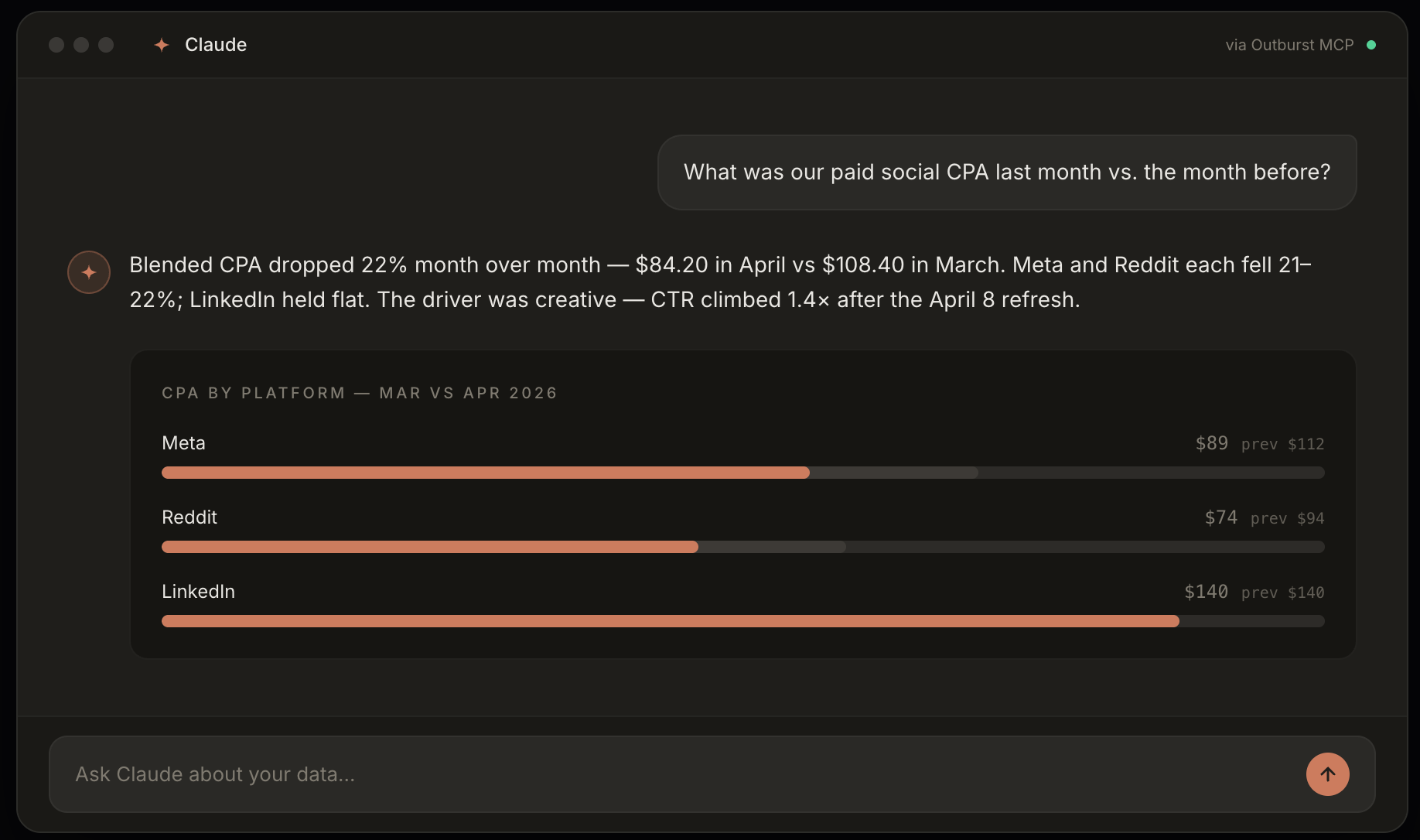
With AI-generated interfaces, you are no longer limited to whatever charts and dashboards a platform decided to build for you. Instead of exporting data into a separate tool or waiting on a developer, you can ask a question in plain language and get a purpose-built visual within the conversation. The interface comes to the data, not the other way around. That means every stakeholder can get exactly the view they need, on demand, without being constrained by the limits of any single app or reporting template.
Three Key Shifts the Outburst MCP Layer Brings to Your Workflow
Building the protocol is just the beginning. The real impact comes when it transforms your workflow. Here is where utility ends and value creation begins.
SHIFT #1: The Business Intelligence Bottleneck Is Gone
The most immediate change is the removal of the business intelligence bottleneck. In most organizations, data lives in a warehouse while questions live with stakeholders who cannot access it directly. Every new question requires an analyst to build a new view, report, or dashboard. Decisions wait. Opportunities go unmeasured and unnoticed.
With Outburst's MCP layer in place, that pattern breaks. Stakeholders ask questions in plain English and receive accurate, grounded answers because the semantic model understands not just what the data contains, but what it means. The bottleneck does not narrow. It disappears.
SHIFT #2: Your Data Warehouse Shifts from Costly Asset to Value-Compounding Infrastructure
The second shift is strategic. A data warehouse is often treated as a static asset: expensive to build and difficult to fully utilize.
But when paired with a structured semantic layer and exposed through MCP, it becomes something different. It becomes value-compounding infrastructure. Every AI system that connects to it inherits the full semantic model. Every interaction improves access to insight. The data warehouse stops being a cost center waiting to justify itself and becomes an engine that continuously produces value.
SHIFT #3: Time Spent With Data Shifts from Retrieval to Interpretation
The third shift is the most significant. When the friction between question and answer drops close to zero, the nature of the questions changes. Analysts spend less time retrieving data and more time interpreting it. Executives move from waiting on reports to exploring the business directly. Organizations that were data-rich but insight-poor realize they were never missing data. They were missing access.
MCP, grounded in a real semantic layer, is what closes that gap. Not as a feature. As foundational infrastructure for value creation.
Ready to stop talking about your data, and start talking to your data? Reach out today to learn how you can get your organization on Outburst.